Wednesday, June 8, 2011

Mother Teresa and the Nobel Peace Prize

Outline what the Nobel peace prize is and the origins of the prize

The Nobel Peace Prize was created by Alfred Nobel, before he died he wrote his will, in it contained the founding principles for the Nobel Peace prize, he wrote that the Nobel Peace Prize should be awarded to someone who:
‘...shall have done the most or the best work for fraternity between nations, for the abolition or reduction of standing armies and for the holding and promotion of peace congresses.’
The first Nobel peace prize was awarded in 1901, by a panel of Norwegian judges, from then on the Nobel Peace Prize Ceremony is held annually and there have been 91 Nobel Peace winners.

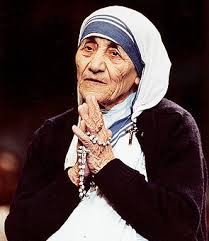
Brief bibliography of the person, include DOB, any education of work history details and their major achievements (include a picture)

Mother Teresa was born in Agnes Gonxha Bojaxhiu in Skopje, Macedonia, on August 26th 1910. At a young age she felt the call of God and she wanted to be a missionary and spread joy, love and happiness to the world.
When she was 18 she joined the Sisters of Loreto in Ireland and soon after was sent to India where she took her vows to become a nun, she became a nun on the 24th May 1931.
Mother Teresa worked in a school slum of India where she taught under privileged children, she was faced with many hardships including extreme poverty.
On October 7, 1950, Mother Teresa received permission from the Holy See to start her own order, "The Missionaries of Charity", her primary focus was to care for the poorest of the poor.
Explain why the person was awarded the prize and when.
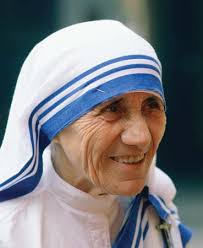
Mother Teresa was awarded the Nobel Peace Prize in 1979. She was recognised for her all the tireless years she spent working towards peace and love throughout the community.  She worked to help the children and the refugees and the very poorest in the community.

Explain why the person became involved in the work

Mother Teresa had always felt that she had a special connection with God and that’s what made her join the ‘The Sister’s of Lorento’ when she was only 18. From then on Mother Teresa worked towards her dream of making the community in which she lived, a happier and safer place.

Mother Teresa and the Nobel Peace Prize

Outline what the Nobel peace prize is and the origins of the prize

The Nobel Peace Prize was created by Alfred Nobel, before he died he wrote his will, in it contained the founding principles for the Nobel Peace prize, he wrote that the Nobel Peace Prize should be awarded to someone who:
‘...shall have done the most or the best work for fraternity between nations, for the abolition or reduction of standing armies and for the holding and promotion of peace congresses.’
The first Nobel peace prize was awarded in 1901, by a panel of Norwegian judges, from then on the Nobel Peace Prize Ceremony is held annually and there have been 91 Nobel Peace winners.

Brief bibliography of the person, include DOB, any education of work history details and their major achievements (include a picture)

Mother Teresa was born in Agnes Gonxha Bojaxhiu in Skopje, Macedonia, on August 26th 1910. At a young age she felt the call of God and she wanted to be a missionary and spread joy, love and happiness to the world.
When she was 18 she joined the Sisters of Loreto in Ireland and soon after was sent to India where she took her vows to become a nun, she became a nun on the 24th May 1931.
Mother Teresa worked in a school slum of India where she taught under privileged children, she was faced with many hardships including extreme poverty.
On October 7, 1950, Mother Teresa received permission from the Holy See to start her own order, "The Missionaries of Charity", her primary focus was to care for the poorest of the poor.

Explain why the person was awarded the prize and when.

Mother Teresa was awarded the Nobel Peace Prize in 1979. She was recognised for her all the tireless years she spent working towards peace and love throughout the community.  She worked to help the children and the refugees and the very poorest in the community.

Explain why the person became involved in the work

Mother Teresa had always felt that she had a special connection with God and that’s what made her join the ‘The Sister’s of Lorento’ when she was only 18. From then on Mother Teresa worked towards her dream of making the community in which she lived, a happier and safer place.

Thursday, May 26, 2011

An article from the Human Rights Declaration

Article 3
  • Everyone has the right to life, liberty and security of person.
My Understanding
Social.
Everyone has the right to live a descent life.
Article 4
  • No one shall be held in slavery or servitude; slavery and the slave trade shall be prohibited in all their forms.  
Rachel's Understanding
Economic
No child labor and cheap labor, only fair working conditions for all workers.

Wednesday, May 25, 2011

Refugees

Refugee: definition
§  Refugees are people who have left their homeland because they fear that they will lose their lives or freedom if they stay. People become refugees because one or more of their basic human rights has been violated or threatened.
§  International law defines a ‘refugee’ as a person who has fled from and/ or cannot return to their country due to well founded fear or persecution including war or conflict.
A person is a refugee if:
§  Refugees have to be outside their country of origin
§  Their reason for flight of fear has to be persecution
§  The fear of persecution has to be well founded, i.e. they have to have experienced persecution or likely to experience it if they return
§  The persecution has to result from one or more of the 5 grounds listed in the definition;
§  They have to be unwilling or unable to seek the protection of their country.
Who protects refugees?
§  UNHCR
§  Protecting refugees is the core mandate of the UNHCR ( United Nations High Commissioner for Refugees)
§  Who do they help?
§  The UNHCR’s primary goal is to help and protect the rights of refugees but they also help
§  Stateless people
§  Women
§  The elderly
§  The disabled
§  They work in more then 110 countries and have helped over 34.4 million people reclaim their lives.

Where are they involved?

§  They work in:
§  Africa
§  The Americas
§  Asia and the pacific
§  Europe
§  The Middle East
§  North Africa


Thursday, April 28, 2011

The Declaration of Human Rights.

 
The Declaration of Human Rights. What are Human Rights?
Human rights are the rights and freedoms that we all have.
Some human rights are based on our physical needs:
the right to life, food, shelter
Other human rights protect us:
The right to be free from torture, cruel treatment and abuse.
Human rights are also there to ensure we develop to our fullest potential:
The right to education, to work, to participate in your community.
Everybody has human rights it doesn’t matter who you are, where you come from, what language you speak or what religion you belong to. You have a duty to respect the rights of others just as they have a duty to respect yours. NOBODY CAN TAKE YOUR RIGHT AWAY
Human rights were officially recognised as values by the world when the UN was set up.
What is the UN?
©       The UN is an international organisation that was established in 1945 the year the Second World War ended.
©       Its founded hoped it would be able to prevent catastrophes like the holocaust from happening in the future.
©       So promoting human rights became an aim of the UN, along with maintaining international peace and reducing poverty.


The Universal Declaration of Human rights(UDHR)
The UN universal declaration of human rights is the most famous human rights agreement in the world. It contains 30 Human Rights.
Who wrote the UDHR?
The people who wrote it came from Australia, Chilie, China, France, Lebanon and many more countries.

Wednesday, April 6, 2011

My Assignment on Desertification

What is a desert?
A desert is a dry place that gets very little rainfall every year.
Plants and animals who live in deserts have adapted in many ways so they can live in the harsh, dry environment.
What is desertification?
Desertification is the spreading of current deserts and deserts beginning to form in non- desert areas. Desertification is a big issue because with all these new deserts animals and plants are losing their homes. An estimated six million hectares of land are lost every year because of desertification.
More than 110 countries are affected by desertification.
Africa is the country that is most covered in deserts 2/3s of the country covered in dry lands or desert.

How does it occur?
The increasing human population lead to increasing demands on our already fragile environment
 Cultivation, overgrazing, deforestation and poor water management can all be contributing factors to desertification.
 The pounding of the soil by the hooves of livestock may degrade the soil and encourage erosion by wind and water- this causes desertification.
What can be done about this issue?
There are many things that are being done to try and combat desertification, these include.
©      Rehabilitate degraded land
©      Planting more seeds for new crops
©      Limiting soil disturbance
©      Reforestation
©      Appropriate animal number
©      Develop renewable energies for heating and cooking

We can do many things that will help this problem such as making people aware of desertification and educating them on what it is all about.

Monday, March 21, 2011

Kiribati and climate change

Kiribiti is a coral atoll , it contains 33 islands and around 100,000 people live there.
The average hieght above sea level is 2m.

What are some of the issues?

  • Overpopulation and sustainability, rising sea levels and climate change will occur before 2030.
  • Climate change will be caused by global warming and the rising sea levels.
  • The country cant grow much fresh produce because plants won't grow in the salty water.
  • As the times goes on there are more and more storms occuring and they are becoming quite violent and are starting to eat away at the island.
  • Lack of fresh water supply.
  • Storm surgues, drought and erosion
  • Government is educating the people and making them more appealing refugees
  • Navy training and nursing is also being taught.

Wheelchairs for students with special needs in Kiribiti- Aus aid